
Lead
In Part One we set a thesis: in the Vibe Coding era, the default should not be frontend-backend separation, but rather "single-language + server-driven UI." We backed it with a formula — Agent output quality is inversely proportional to the product of languages, seams, and structural uncertainty — and with a scoreboard showing server-driven forms pulling far ahead of separated ones.
The skeptic will say: "But my team already separated, and it works." That is true for human teams, and Part One already conceded the organizational cases where separation earns its keep. This article is not about those teams. It is about the moment an AI is the one generating and maintaining the code — because in that moment, the human-coordination rationale for separation dissolves, and a new efficiency curve appears. What follows is a concrete instance of that curve, using tools you can stand up today.
But a thesis needs a body. For an idea to be useful, it needs a concrete, reusable skeleton an engineer can actually stand up on a Monday morning. This article uses Laravel + Filament as a case study to answer one question: why is it precisely this combination that is most friendly to AI (and, as we will see, to humans)?
The answer is not in some flashy feature, but in a chain of architecture decisions that "subtract": single language, fewer seams, fixed conventions, server-driven, built-in abstractions. Stacked together, they drive the Agent's "cognitive load" to its lowest point. We will look at the skeleton itself, decompose the five simplifications, examine how it becomes genuinely AI-native, and close with the dogfooding loop that makes the whole thing self-sustaining.
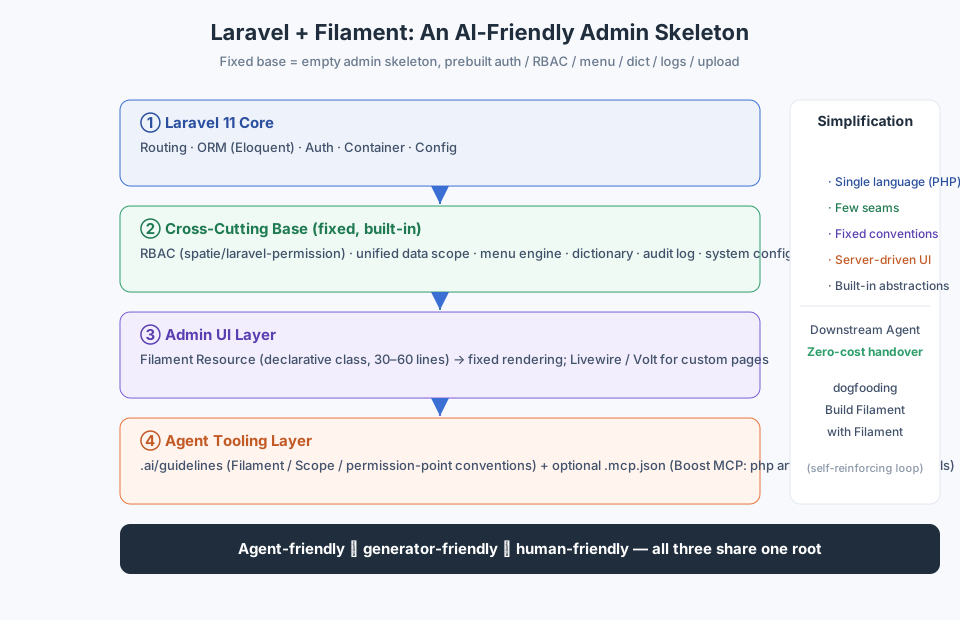
I. What This "Empty Admin Skeleton" Looks Like
Let's first define the object under discussion clearly. Not "an empty project with Filament installed," but an empty admin skeleton that presets common admin capabilities:
- Based on Laravel 11;
- Admin UI built with Filament (optionally layered with Livewire / Volt for interactive components);
- Integrated with Boost (provides the Agent tooling ecosystem, detailed below);
- Preset capabilities: authentication, RBAC (permission-point-based role control), menu engine, data dictionary, operation log, system configuration, and file upload.
In other words, what the developer / AI receives is not a blank sheet, but a starting point that has "already laid out 80% of the repetitive infrastructure." Adding a new business module is mainly about writing one PHP declaration class, rather than building routing, auth, and menus from scratch one by one.
Why does this matter for AI? Because repetition is where generators are both most valuable and most error-prone. The boring 80% — "how do users log in," "how do we record who changed what," "how does a menu item appear" — is exactly the scaffolding an Agent tends to get subtly wrong when it generates from nothing. By front-loading that scaffolding, the skeleton removes the riskiest generation surface and leaves the Agent only the interesting 20%: your actual domain.

The beauty of this skeleton is that its "presets" are not piled on randomly, but rather front-load the "architecture decisions," so that every downstream generation lands on a deterministic track. The Agent is not being given more to learn; it is being given fewer decisions to make. That distinction is the whole game.
Concretely, consider what "add a module" means here versus from scratch. From scratch, the Agent must create a migration, a model, a controller, a set of routes, an auth gate, a menu entry, a Vue list component, a Vue form component, a TypeScript type, and an API client — ten or more files across two languages, each a fresh chance to disagree with the others. In the skeleton, the Agent adds one PHP Resource class and, if needed, one row in the permission seeder. The other nine files already exist as prescribed behavior. The generation surface shrinks by an order of magnitude, and so does the failure surface.
II. Five Pillars of Architectural Simplification
Why is it friendly to AI? Unpacking it, there are five mutually reinforcing simplification points. Each one maps directly onto a denominator in the Part One formula.
① Single language (PHP). The Agent only needs to write one language. No TypeScript types to maintain, no frontend build chain to understand, no switching cost between "two mental models." The "language count" denominator in the formula converges straight to 1. Concretely, when the Agent adds a field to a form, it edits one PHP file; it does not also open a .d.ts, regenerate a client, and re-run a type check. One change, one place, one mental model.
② Few seams. A Filament Resource is a declaration class, typically about 30–60 lines, that describes "list + form + filters + actions" clearly. It is not a two-part "backend contract + frontend component" structure, but one declaration, rendered at two ends. The "seam count" denominator in the formula is driven extremely low. There is no API contract to keep in sync with a UI, because the UI is generated from the same declaration that defines the data.
③ Fixed conventions. The directory layout, naming rules, and Resource method signatures are all predictable. Locations like app/Filament/Resources/, app/Filament/Pages/ are conventions; where the Agent's generated output "lands, what it's called" is highly certain, and the probability of "generated once and already compliant" rises significantly. The "structural uncertainty" denominator in the formula is pushed down. The Agent does not deliberate about placement; it follows the road already paved.
④ Server-driven UI. Data is owned by the backend, the rendering base is provided by Filament — no hand-written REST contract, no frontend type drift, no CORS. The frontend "state" is hosted by backend components, so the Agent doesn't have to reason about "how the two sides align." The hardest class of Vibe Coding bug — the contract that almost matches — simply cannot occur, because there is no contract across a process boundary.
⑤ Built-in abstractions. Authentication, permissions, ORM (Eloquent), and the Admin interface are all presets of the framework / base. The Agent doesn't reinvent the wheel, but "calls existing abstractions." Every wheel not reinvented is one fewer failure point, one fewer chunk of code the Agent must understand and maintain. When the Agent needs auth, it reaches for the preset; when it needs a table, it reaches for the preset. The surface area of generated code shrinks toward zero, and the surface area of understood code is the well-documented framework the Agent was trained on.
To make the cumulative effect concrete: an Agent tasked with "add a comment-moderation screen" in this skeleton opens one file, declares a table and a form in PHP, and is done. It never decides on a build tool, never writes a type, never configures CORS, never wires a router. Five denominators were quietly minimized before the Agent wrote a line. The result is not that the Agent is smarter; it is that the architecture removed the places where it could be wrong.
These five points together exactly correspond to the five dimensions where Laravel + Livewire / Volt scored a full 5 in the comparison matrix of Part One: single-language friendliness, context / token cost, seam count, scaffold determinism, and Agent tooling ecosystem. Architectural simplification is not a subjective preference, but a measurable "Agent friendliness." When you optimize those five denominators, the scoreboard takes care of itself.
III. Making AI-Native Features Concrete: Outputs Carry "Handover-Ready" Context
What truly makes this skeleton "AI-native" is not just "less," but that it actively prepares context for downstream Agents. A skeleton that is merely small still leaves the Agent to discover its conventions by trial and error. An AI-native skeleton instead ships the conventions as data the Agent can read.
The first layer is .ai/guidelines — a convention document that travels with the project and is written for the Agent to read, solidifying at least three kinds of conventions:
- Filament conventions: how to write a Resource, how to mount a Page, how to use components;
- Data scope conventions: how tenant / organization / user data visibility ranges are expressed;
- Permission point naming convention: unified as
{module}.{action}(e.g.,posts.create,posts.publish), mapping permission points one-to-one with code, so the Agent understands the semantics just from the name.
The second layer is the optional .mcp.json — exposing Boost MCP. The MCP service started via php artisan boost:mcp provides the Agent with 15+ tools (such as reading Resources, generating migrations, checking permission points, running convention validation, and so on). The Agent doesn't need to "guess" the project structure, but directly calls tools to "see" and "modify."
// .mcp.json (illustrative: expose Boost MCP to downstream Agents)
{
  "mcpServers": {
    "boost": {
      "command": "php",
      "args": ["artisan", "boost:mcp"]
    }
  }
}
# .ai/guidelines (excerpt)
## Permission point naming
- Format: {module}.{action}
- Examples: posts.create / posts.publish / users.impersonate
- Every action inside a Resource must map to one permission point
## Data scope
- Multi-tenant field is unified as tenant_id
- Resources apply TenantScope by default; bypassing in list queries is forbidden
This means: when a new Agent (human or model) takes over this project, it gains "what this project looks like, what conventions to follow, what tools are available" at zero cost — which is exactly the key to Vibe Coding's "handover means immediate productivity." Imagine the alternative: an Agent dropped into a bare Laravel repo must infer the team's permission conventions from scattered middleware and hope it guesses right. With .ai/guidelines, the conventions are explicit, version-controlled, and impossible to misread. The .mcp.json goes further: instead of reading files and guessing, the Agent calls a tool and is told, precisely, what exists. That is the difference between an intern reading the codebase and a senior engineer with the schema open.
Think about the economics of this for a moment. In a conventional separated codebase, onboarding a new contributor — human or model — carries a tax: they must reconstruct the team's hidden conventions (where types live, how auth flows, what the permission vocabulary is) from scattered clues. That tax is paid on every handover, forever. Here, the conventions are a file and a tool, so the tax is paid once, by the person who wrote the skeleton, and amortized across every future session. The skeleton is, in effect, a one-time upfront payment that converts an open-ended recurring cost into a fixed one.
IV. The Dogfooding Loop: Generating Filament with Filament
There is also a design that is easy to overlook yet best embodies "friendliness": dogfooding.
The generator itself also consumes the capabilities of this base. In other words, the tool used to "generate the admin" is itself an admin running on Laravel + Filament — it uses Filament's Resource to describe the "module to be generated," uses Filament's form to receive parameters, and uses Filament's menu to organize functions.
This forms a closed loop:
A generator written in Filament → generates more Filament applications → those applications can in turn be maintained by the same generator.
For AI, this means the "generation logic" and the "generated artifacts" share the same mental model. Once the Agent learns one set of conventions, it can both maintain business applications and maintain the generator itself. Maintenance cost does not grow linearly with system scale, because everything grows on the same skeleton.
The payoff compounds. A traditional code generator is a separate program with its own stack, its own bugs, and its own learning curve — so the team ends up maintaining two things. Here, the generator is just another Filament app, so the Agent (or human) that maintains your business admin is already trained on the exact patterns the generator uses. There is no second world to context-switch into. As the system grows from ten modules to a hundred, you do not add a second architecture; you add more of the same. That is what "maintenance cost does not scale linearly" really means in practice.
Consider what this means at the scale of a real product. A typical internal platform accumulates dozens of modules over a few years: billing, ticketing, inventory, reporting, audit, and so on. Under a separated architecture, each new module is a small separate application, and the integration surface grows with every addition — every module potentially disagrees with the shared contract. Under the dogfooding skeleton, each new module is one more Resource on the same spine. The generator that built the first one builds the fiftieth identically. The marginal cost of a module approaches the cost of describing it, which is exactly what you want automation to achieve.
Conclusion: Friendly to Agents Ultimately Means Friendly to Humans
Stringing the above points together yields an equation worth remembering:
Golden line: Friendly to Agents ≡ friendly to generators ≡ friendly to humans — they share the same source.
- Friendly to Agents: single language, fewer seams, fixed conventions, built-in context;
- Friendly to generators: the same declarative model can describe both business and generation logic;
- Friendly to humans: humans read the same PHP declaration class, modify the same piece of code, and don't have to jump back and forth between frontend and backend.
These three are not three different properties that happen to coincide; they are one property seen from three angles. A single declaration that the Agent writes, the generator emits, and the human reads is the same artifact. Reduce the artifacts, and you reduce the friction for all three actors at once.
Choosing Filament as the admin skeleton is essentially not "picking a UI library," but paying in advance for "AI taking over maintenance" — the little extra cost you spend today solidifying conventions and wiring up tools pays compounding dividends on every future generation, every maintenance pass, every handover. The upfront investment is small: a guidelines file, an MCP entry, a few preset capabilities. The return is that every future interaction with this codebase — by a model or by a person — starts from a known, stable place rather than from a blank guess.
None of this requires abandoning good engineering. The skeleton still produces real, inspectable PHP; it still respects Laravel's conventions; it still lets a senior engineer drop to a lower level when a module genuinely needs it. "Integrated by default" is a default, not a cage — and that distinction is what makes it safe to adopt widely while keeping an escape hatch for the rare case that truly needs separation.
In the next article, we shift the perspective to the domestic line: using ThinkPHP + Vue, can we replicate the same experience? The answer is yes, but we must honestly face the gap in "Agent friendliness" and offer a path to bridge it. The principle travels across frameworks even when the tooling does not yet.