
Lead
For the past decade, "frontend-backend separation" has been the undebated, default starting point for web applications. A frontend repo here, a backend repo there, joined by a REST / OpenAPI contract in the middle — this combination became muscle memory for countless teams. It was a reasonable response to a real problem: as apps grew, letting interface specialists and server specialists work in parallel, in their own stacks, with their own release cadences, simply scaled better than cramming everyone into one monolith.
But now that Vibe Coding (AI-assisted end-to-end code generation) has entered our daily work, we have to pull that muscle memory back out and examine it under new light. The premise of Vibe Coding is that an AI Agent can act as the "lead engineer" and generate a working application from a prompt — scaffolding, routes, models, UI, and all. When the same intelligence is responsible for both sides of the contract, the organizational justification for separation weakens, and a different set of constraints comes to the front.
In a scenario where an AI generates the entire application from scratch and is expected to actually run it, is separation-by-default still the optimal choice? This article's conclusion is clear: not necessarily. At least for a large category of scenarios — admin panels, internal systems, and standard CRUD — the more robust first principle in the Vibe Coding era is "single-language by default + server-driven UI."
That is a strong claim, so the rest of this article builds it up step by step: first the constraints an AI Agent actually fights against, then why classic separation makes all of them worse, then why full-stack integration makes them better, then a side-by-side scoreboard, and finally an honest account of where separation still earns its keep.
I. When an AI Agent Generates End-to-End, It Faces Three Core Constraints
When we ask an AI Agent to generate an admin application from zero to one and actually run it, it is essentially wrestling with a harsh physical reality: it cannot "see" the entire world at once. An LLM has a finite context window, a finite budget of tokens it can spend before it starts forgetting or hallucinating, and a finite tolerance for ambiguity. The quality of any generative Agent's output is governed by three constraints.
Constraint 1: Context window and token cost. An Agent can only fit a limited number of files into its context window at a time, and every additional language or build chain eats into a context budget that could otherwise be spent on "understanding the business." The fewer languages and files, the more the Agent can focus its attention on the business logic that actually matters. Put concretely: if half the window is occupied by TypeScript build config and half by PHP runtime config, there is little room left for the Agent to reason about what the feature should do. Language is not free; every syntax the Agent must hold in its head is tokens it cannot spend on your domain.
Constraint 2: Number of seams. Every additional process boundary or contract boundary creates a second "source of truth" — frontend types on one side, backend contract on the other, the two naturally prone to drift — and simultaneously adds a class of integration failure points, forcing the Agent to reason extra about "how the two sides line up." A seam is any place where two independently generated artifacts must agree. The more seams, the more the Agent has to play matchmaker between pieces it generated separately, and the more chances for a mismatch to slip through. Seams are where alignment errors are born.
Constraint 3: Scaffold determinism. The more predictable the directory layout and naming conventions, the higher the probability that the Agent "generates correctly on the first try." Conversely, the more divergent the structure, the more likely the Agent is to err on "where should this file go, what should it be called," wasting effort on assembly rather than logic. Determinism is a multiplier on reliability: when the Agent knows exactly where things live, it spends its reasoning budget on behavior, not on archaeology.
These three constraints can be condensed into a plain formula — it is not a rigorous theorem, but it is an actionable yardstick that has held up well across real generation runs:
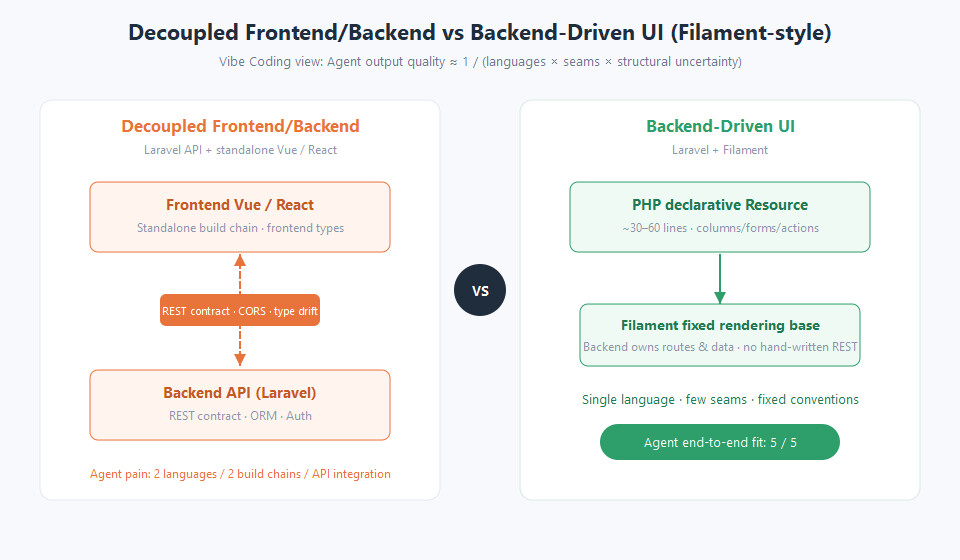
Agent output quality ≈ 1 / (number of languages × number of seams × structural uncertainty)
The smaller the denominator, the higher the quality. It tells us a simple fact: any architecture that can "subtract" across these three denominators will make AI generation more stable, cheaper, and less prone to failure. The rest of this article is essentially an argument that classic separation inflates all three, while server-driven integration shrinks all three.
II. Frontend-Backend Separation Amplifies All Three Denominators at Once
Now apply the formula above to "frontend-backend separation," and the conclusion may be uncomfortable: the classic separated form (take Laravel API + Vue as an example) adds to almost every denominator.
Language count ×2. Backend in PHP (or another server-side language), frontend in TypeScript. Two syntaxes, two sets of standard-library mental models, two kinds of error semantics — the Agent has to switch back and forth between two "worldviews," and the context budget is split in half on the spot. It is not merely that two languages are present; it is that the Agent must keep both loaded simultaneously to make them agree. A type defined on the backend must be re-expressed on the frontend, and the Agent must hold both representations in mind to avoid drift.
Seams sprawl open. Routes duplicated on both sides, CORS configuration, auth-flow token passing, serialization / deserialization, frontend state management… each is an independent failure point. Where Agents most often stumble is frequently not the business logic itself, but "interface integration" and "frontend-backend type mismatch" — precisely the densest seam zone of a separated architecture. In practice, a generated Vue app will confidently call /api/posts while the generated Laravel controller actually registered /api/post, or the TypeScript Post type will have drifted one field away from the Eloquent model. These are not logic bugs; they are seam bugs, and they are the most common kind.
Structural uncertainty runs high. The frontend has its build chain (Vite / Webpack) and its own directory conventions (components / views / store), while the backend has its own. The two scaffolds evolve separately, diluting the probability of "generated once and already compliant." When the Agent generates a new component, where does it go — resources/js/views/ or resources/js/pages/? When it adds a route, does it touch the Vue router or the Laravel route file? Every such fork is a coin flip the Agent must get right, and wrong answers produce apps that do not even boot.
This is why, in Vibe Coding real-world tests, Agent errors cluster heavily around seam problems like "contracts don't line up, types drifted, CORS blocked" rather than the business algorithms themselves. The cost of separation is amplified by AI generation — the bill you pay for "organizational decoupling" becomes especially expensive in the context of "AI writing on your behalf." What bought you team autonomy when humans owned each side now buys you integration debt when a single Agent owns both.
Compare two typical code snippets. In the separated form, the backend must first define a contract, and the frontend writes matching types again:
// Backend: Laravel API Controller (separated form)
Route::get('/api/posts', [PostController::class, 'index']);
// Frontend: Vue component + axios + hand-written TypeScript types
const res = await axios.get<Post[]>('/api/posts');
In the server-driven form, this entire "contract + types" disappears, leaving only a single declaration. There is no second artifact to keep in sync because there was never a second artifact. This is exactly the main thread the next article will unfold.
III. Full-Stack Integration: All Three Denominators Converge Simultaneously
Looking the other way, the "full-stack integration" route — a single-language codebase + server-driven UI (such as Livewire, Inertia, HTMX, Reflex, and the like) — happens to subtract across all three denominators of the formula in sync.
Language count converges to 1. Take Laravel + Livewire / Volt as an example: page interactions are expressed in PHP components, there is no separate frontend build chain, and the Agent writes only one language, PHP. The whole mental model is one stack. The Agent never has to translate a domain concept across a language boundary, because there is no boundary.
Seam count converges. Routing, data, and rendering all live within a single process — no CORS, no extra serialization contract, no "alignment" problem between a frontend state machine and a backend response. The boundaries the Agent must reason about are greatly reduced. The only "contract" is the method signature of a component class, and the Agent generated that class itself in the same pass, so there is nothing external to disagree with.
Structural uncertainty converges. The server-side framework's directory conventions are stable; where the Agent's generated output "lands" is highly predictable, and the probability of "generated once and already running" rises significantly. Laravel always expects resources under app/..., and Livewire always expects components under a known path. The Agent is not guessing; it is following a well-trodden road.
In other words, full-stack integration is not a "technical regression," but rather a systematic lowering of uncertainty in the context of AI generation. It is not that we are giving up the benefits of modern tooling; it is that we are relocating the complexity from a place the Agent struggles with (cross-process contracts) to a place it handles well (in-process declarations). It releases the Agent's attention from "how do I align the two sides" back to "what does the business actually need."

IV. A Comparison Matrix That Reveals the Gap
To turn "gut feeling" into "comparable numbers," we scored several forms on six dimensions from 0–5 (higher score = more suitable for Vibe Coding generation): single-language friendliness, context / token cost, seam count, scaffold determinism, Agent tooling ecosystem, and interaction capability.
| Form | Single-Lang | Context Cost | Seams | Scaffold Det. | Agent Tooling | Interaction | Overall | | ----------------------------- |:-----------:|:------------:|:-----:|:-------------:|:-------------:|:-----------:|:-------:| | Laravel + Livewire / Volt | 5 | 5 | 5 | 5 | 5 (Boost) | 4 | 5 | | Laravel + Inertia | 4 | 4 | 4 | 5 | 4 | 5 | 4.5 | | Laravel API + Vue (separated) | 2 | 2 | 2 | 2 | 2 | 5 | 2 |
A few takeaways:
- Server-driven forms nearly max out all five denominator dimensions: single-language friendliness, context cost, seams, scaffold determinism, and Agent tooling ecosystem all score 4–5. Their cost is mainly in "interaction capability" — the ultimate interactive feel of pure Livewire is slightly inferior to a native SPA. If your app is fundamentally a forms-and-tables admin surface, that trade is almost always worth it.
- The separated form scores only 2 across the board; its sole advantage, "interaction capability," comes from the expressive power of the frontend framework itself, but that is precisely the part that requires extra cost to maintain — equivalent to paying the highest maintenance price for a capability it should have had anyway. You are subsidizing the SPA feel with dual languages, dual scaffolds, and a standing integration burden.
- Inertia is the compromise: interaction capability maxed out (close to SPA experience), at the cost of single-language friendliness and seams being slightly inferior to pure Livewire (there is still a frontend type layer and a bridge). It fits scenarios where you "want the SPA feel but don't want to hand-write REST contracts." It keeps you in one framework family while still delivering snappy client-side navigation.
The scores are relative judgments, not absolute values; dimension weights also vary by project. But they clearly point to one conclusion: when it comes to "suitable for AI generation," server-driven forms crush separated forms. The spread between 5 and 2 is not noise; it reflects a structural difference in how much the architecture fights the generator.
V. When Separation Is Still the Right Choice
To be honest, "not separating" is not a silver bullet. In the following three categories of scenarios, frontend-backend separation is still worth choosing — and pretending otherwise would be as dogmatic as the original "separate by default" reflex we are questioning.
- Extremely high interaction complexity: real-time collaboration (e.g., multi-user co-editing of documents), heavy client-side state (e.g., complex drag-and-drop orchestration), offline-first (PWA / local-first), and clear multi-end targets (Web + native App sharing one backend). The "interaction / state" cost of these scenarios is worth paying the "dual-language + multi-seam" price, because no server-driven abstraction currently matches the raw control a hand-built SPA gives you over the client.
- Large organizations with parallel frontend and backend teams: when two teams are independently staffed and independently scheduled, the "decoupling" brought by separation has organizational value, far more important than "the Agent saving one context." If a 40-person frontend guild and a 60-person backend guild must ship on different clocks, the contract is the coordination mechanism, not a nuisance to be eliminated.
- An existing independent frontend middle-platform or design system: when the company already has a mature component library, design-token system, and frontend engineering infrastructure, forcibly reverting to server-driven UI would waste existing assets. The sunk cost is real, and the migration risk may outweigh the generation dividend for a long time.
The standard for judgment is actually one sentence: whether your "interaction / organizational complexity" is high enough to be worth paying the "dual-language + multi-seam" AI-generation cost. If the answer is "yes," choose separation and keep choosing it; if the answer is "most admin CRUD scenarios," then separation-by-default is just inertia, not a trade-off that has been weighed. The point of this series is not to ban separation, but to stop reaching for it on autopilot.
Conclusion: What "Not Separating" Looks Like in Practice
So what does "not separating" look like in code? Take Laravel + Filament as an example: you declare a Resource class in PHP, Filament provides a fixed rendering base, the backend firmly owns routing and data, there is no hand-written REST contract, and no frontend type drift:
// app/Filament/Resources/PostResource.php
use Filament\Resources\Resource;
use Filament\Tables;
use Filament\Forms;

class PostResource extends Resource
{
    protected static ?string $model = Post::class;

    public static function table(Tables\Table $table): Tables\Table
    {
        return $table
            ->columns([
                Tables\Columns\TextColumn::make('title')->searchable(),
                Tables\Columns\TextColumn::make('author.name')->label('作者'),
                Tables\Columns\IconColumn::make('published')->boolean(),
            ])
            ->filters([
                Tables\Filters\SelectFilter::make('author')
                    ->relationship('author', 'name'),
            ])
            ->actions([Tables\Actions\EditAction::make()]);
    }

    public static function form(Forms\Form $form): Forms\Form
    {
        return $form->schema([
            Forms\Components\TextInput::make('title')->required(),
            Forms\Components\RichEditor::make('body'),
        ]);
    }
}
A roughly 30–60 line PHP declaration class describes a complete admin list page + form page. The AI only needs to understand one world — "PHP declarations + a fixed base" — with no second language and no second contract. Notice what is not here: no API route file, no TypeScript interface, no axios call, no CORS middleware, no duplicate model representation on the client. The absence is the whole point. The Filament base absorbs the rendering, the framework absorbs the routing, and the developer (human or Agent) is left with pure declaration.
Golden line: In the Vibe Coding era, the first principle is to swap the muscle memory of "separate by default" for "single-language + server-driven UI by default."
This is also the core judgment this series aims to carry through. In the next article, we use Laravel + Filament as a case study to break down why "not separating" is especially friendly to AI; in the article after that, we move the same logic to ThinkPHP + Vue, proving that this route is not bound to any single language. The architecture may change skins, but the principle stays.